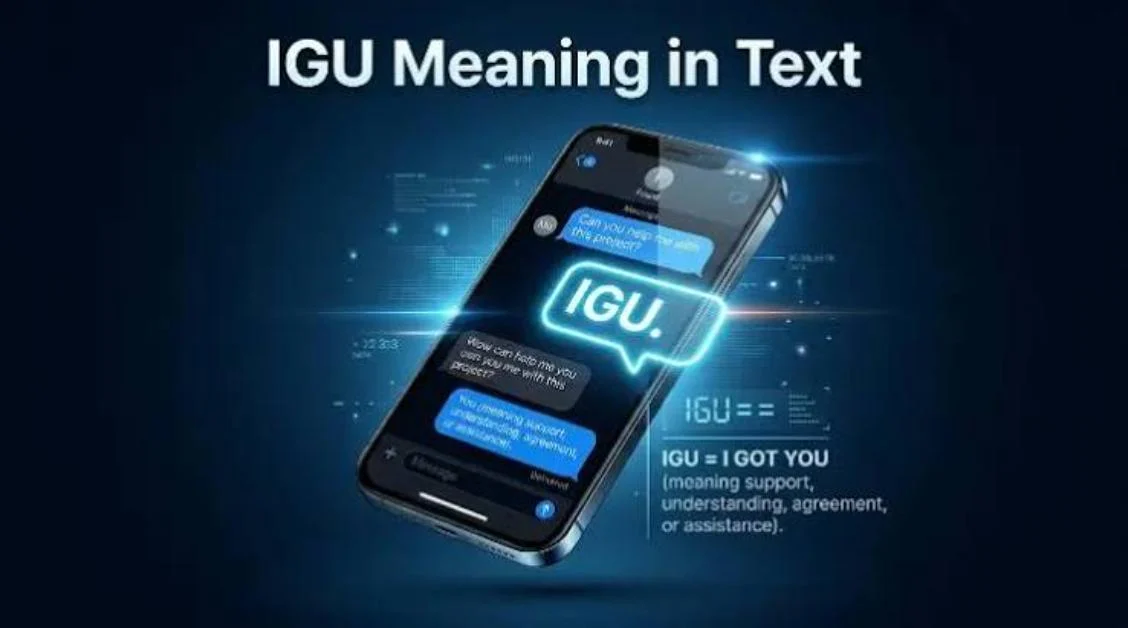
If you have seen “IGU” in a text message, social media comment, or online chat, you may wonder what it means. Internet slang can be confusing because the same short form may have different meanings depending on the conversation.
IGU meaning in text is often connected with phrases such as “I got you,” especially when someone wants to show support, understanding, or agreement. However, context matters because IGU can also have other meanings outside casual texting.
People commonly search for this abbreviation because they want to understand a message quickly before replying. In this guide, we will explain what IGU means in text and chat, its possible full forms, how people use it on popular social platforms, and how to respond naturally.
We will also cover common mistakes, examples, related slang, and frequently asked questions.
What Does IGU Mean in Text & Chat?
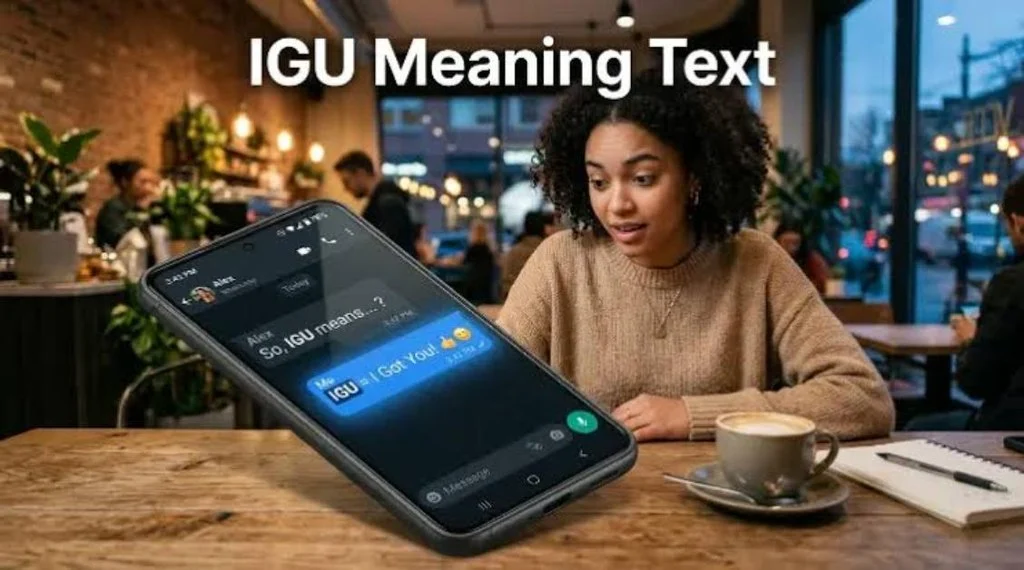
In texting and casual online conversations, IGU most commonly means “I Got You.” It is a short way to tell someone that you understand them, will help them, or have their situation under control.
The exact meaning depends on the context. When a friend says something like “Can you send me the notes later?”, a reply such as “IGU” can mean “I got you” or “Sure, I’ll take care of it.”
People use IGU because texting often favors short and quick expressions. Instead of typing the entire phrase, someone can simply write three letters.
For example:
- Friend: “Can you save me a seat?”
- Reply: “IGU 👍”
Here, IGU means “I got you.”
It can also communicate emotional support:
- Friend: “I’m having a rough day.”
- Reply: “IGU ❤️”
In this situation, the phrase may mean something closer to “I understand” or “I’m here for you.”
Quick meaning of IGU in texting
- IGU = I Got You
- It can mean I understand
- It can mean I’ll help you
- It can mean I’ll take care of it
- It can show support or reassurance
Because abbreviations can have multiple meanings, it is always better to look at the surrounding message before deciding what IGU means.
Full Form, Stands For & Short Meaning of IGU
The most common texting expansion of IGU is “I Got You.” It is an informal expression used between friends, family members, classmates, coworkers, and people chatting online.
“I got you” has several related meanings in everyday English. Someone might use it to say they understand what another person is saying. They might also use it to promise help or confirm that they will handle something.
For example:
- “Can you pick me up at 7?”
- “IGU.”
This means, “I got you,” or “Yes, I will pick you up.”
Another example:
- “I don’t know how to do this assignment.”
- “IGU. I’ll explain it.”
Here, IGU expresses willingness to help.
The short form is particularly useful in fast conversations where people do not want to type complete sentences.
IGU can communicate:
- Understanding: “I understand what you mean.”
- Support: “I’m here for you.”
- Agreement: “Okay, I’ll do it.”
- Help: “I’ll help you.”
- Reassurance: “Don’t worry; I’ll handle it.”
It is important not to assume that every use of IGU has exactly the same meaning. Tone and context can change the interpretation.
For SEO readers researching IGU meaning in text, the simplest answer is:
IGU usually means “I Got You” in casual texting and online chat.
You may also want to explore related abbreviation pages such as [IG meaning in text], [IDK meaning in text], and [IYKYK meaning in text] to understand other common internet expressions.
Origin, History & First Known Use of IGU
Unlike some slang terms with a clearly documented origin, the texting abbreviation IGU does not have one universally established first-use date. It developed naturally from the spoken phrase “I got you,” which has long been used in informal English.
As texting, instant messaging, and social media became more common, users began shortening familiar phrases to save time. Abbreviations such as LOL, BRB, IDK, and IMO became widely recognized. Short forms like IGU can be understood as part of this broader habit of compressing everyday language.
The phrase “I got you” itself can have several meanings in spoken English. A person might say it when they understand something, promise assistance, or reassure another person. Online users can preserve those meanings while shortening the phrase.
The rise of smartphones also made quick abbreviations more practical. People often communicate through short messages, comments, direct messages, and group chats. Three letters can replace an entire phrase without slowing down the conversation.
Important points about IGU’s development
- It comes from the informal phrase “I got you.”
- It fits the broader culture of internet abbreviations.
- Its exact first online use is not clearly established.
- Its meaning depends heavily on context.
- It is mainly associated with casual communication.
So, rather than treating IGU as a term with one specific inventor, it is more accurate to view it as a shortened form that developed through informal digital communication.
How People Use IGU in Daily Conversations
People usually use IGU when they want to respond quickly while showing understanding, support, or willingness to help.
One common use is when someone asks for a favor. Instead of replying with a longer sentence such as “Sure, I will take care of that,” they can simply say “IGU.”
For example:
- “Can you bring some water?”
- “IGU 👍”
The abbreviation can also be used after someone explains a problem.
- “I can’t make it tonight because I’m sick.”
- “IGU. Get some rest.”
Here, IGU can carry the feeling of “I understand.”
Friends may also use it to reassure each other.
- “Don’t worry about the project. I’ll help you.”
- “Thanks! IGU too 😊”
In some conversations, the phrase may have a stronger supportive meaning. Someone could write “IGU ❤️” to communicate that they understand what another person is going through.
Common situations where IGU appears
- Asking for help
- Accepting a request
- Offering reassurance
- Showing understanding
- Supporting a friend
- Confirming that something will be handled
- Responding quickly in a group chat
Because IGU is informal, it usually works better in relaxed conversations than in formal business writing.
For example, sending “IGU” to a close friend is natural. Sending it to a customer or writing it in a formal report may sound too casual.
IGU Meaning Across WhatsApp, Instagram, TikTok & Snapchat
The meaning of IGU generally stays similar across social media platforms. On WhatsApp, Instagram, TikTok, and Snapchat, users may use it as a shortened version of “I got you.”
On WhatsApp, IGU can appear in private messages or group chats. Someone might use it to confirm that they will complete a task or help another person.
Example:
- “Can you send the address?”
- “IGU.”
On Instagram, the abbreviation may appear in direct messages or comments. It can be a quick response to a friend or follower.
On TikTok, people may use IGU in comments or direct messages. However, the meaning should still be interpreted from the surrounding conversation rather than the platform itself.
On Snapchat, where communication is often short and casual, abbreviations can be especially convenient.
Platform examples
- WhatsApp: “Need me to bring snacks?” — “IGU 😂”
- Instagram: “Thanks for explaining!” — “IGU!”
- TikTok: “Can you send me that video?” — “IGU.”
- Snapchat: “I forgot my charger.” — “IGU, I have one.”
The important point is that IGU does not automatically have a different meaning on each platform. In casual chat, “I Got You” remains a common interpretation.
Still, social media users create new slang quickly, so context should always guide your interpretation.
Different Meanings of IGU in Other Fields
Although IGU meaning in text usually refers to “I Got You,” the abbreviation can have different meanings outside casual online conversations.
This is an important distinction because abbreviations are not limited to texting. The same three letters may represent an organization, technical term, educational institution, or industry-specific phrase.
For example, IGU may be used as an abbreviation for a university or organization name. It can also appear in technical or professional contexts where the meaning has nothing to do with texting.
That means the surrounding information is essential.
Consider these two situations:
- “Don’t worry, IGU 😊”
- “The IGU conference will take place next month.”
The first example strongly suggests informal slang. The second looks like an institutional or organizational abbreviation.
Before interpreting IGU, ask:
- Is this a personal text?
- Is the conversation casual?
- Is someone asking for help?
- Is the person reassuring you?
- Is IGU written as part of an organization or official name?
- Are there technical terms around it?
If the answer involves casual conversation, “I Got You” is a reasonable interpretation. If the abbreviation appears in an academic, business, technical, or official setting, another meaning may apply.
This is why dictionary-style answers should not treat every use of IGU as identical. Context determines meaning.
Common Confusions, Mistakes & Wrong Interpretations
One of the biggest mistakes people make with IGU is assuming that every abbreviation has only one possible definition.
In casual texting, IGU commonly means “I Got You.” However, some readers may confuse it with similar abbreviations or interpret the letters individually.
Another common mistake is assuming that IGU always means “I understand.” Understanding can be part of the phrase, but “I got you” may also mean “I’ll help you” or “I’ll take care of it.”
For example:
- “Can you cover my shift?”
- “IGU.”
Here, the meaning is closer to “I’ll take care of it” than simply “I understand.”
Common mistakes
- Assuming IGU has one meaning everywhere
- Confusing it with IG, which often means “Instagram” or “I guess”
- Treating it as formal language
- Ignoring the surrounding conversation
- Assuming it always means emotional support
Tone can also change the meaning.
“IGU 👍” may sound confident and helpful.
“igu…” might feel more casual or uncertain depending on the conversation.
When in doubt, look at what was said immediately before IGU. The previous message often makes the intended meaning obvious.
Similar Terms, Alternatives & Related Slang
Several texting expressions are related to IGU because they communicate understanding, agreement, support, or willingness to help.
Some are almost interchangeable in certain situations, while others have different meanings.
Related texting terms
- I got you — I understand or will help.
- Gotcha — I understand.
- I understand — A clearer, more direct version.
- No worries — Everything is okay.
- Sure — Agreement or acceptance.
- NP — “No problem.”
- TY — “Thank you.”
- IDK — “I don’t know.”
- IKR — “I know, right?”
- FR — “For real.”
For example, if someone asks:
“Can you help me with this?”
You could reply:
- “IGU.”
- “Gotcha.”
- “Sure!”
- “No worries.”
These responses have similar supportive functions, but they are not exact replacements in every situation.
If someone says “I’m really stressed today,” replying “IGU” may communicate understanding and support. Saying “NP” would not express exactly the same idea.
Understanding these small differences can make online conversations easier and help you choose a response that matches the tone.
For more related slang, consider internal links to pages such as [FR meaning in text], [NP meaning in text], [IKR meaning in text], and [IDK meaning in text].
Examples of IGU in Real Chat Situations
Seeing IGU in realistic conversations makes its meaning much easier to understand. In most casual examples, it works as a short form of “I got you.”
Example 1: Asking for a favor
- Alex: “Can you pick me up after class?”
- Sam: “IGU 👍”
Meaning: “Sure, I’ll pick you up.”
Example 2: Offering support
- Alex: “I have so much work today 😭”
- Sam: “IGU. Let me help.”
Meaning: “I understand / I’m here to help.”
Example 3: Confirming a task
- Alex: “Can you send the file tonight?”
- Sam: “IGU.”
Meaning: “Yes, I’ll take care of it.”
Example 4: Showing understanding
- Alex: “I can’t come because something came up.”
- Sam: “IGU, no worries 😊”
Meaning: “I understand.”
Example 5: Friendly reassurance
- Alex: “I’m nervous about tomorrow.”
- Sam: “IGU ❤️ You’ll be okay.”
Meaning: “I understand what you’re feeling and support you.”
Quick takeaway
When you see IGU in a friendly conversation, try replacing it with “I got you.” If the sentence still makes sense, that is likely the intended meaning.
How to Reply When Someone Says IGU
Your response to IGU depends on what the person means by it. Since IGU often communicates help or understanding, a simple response is usually enough.
If someone says:
“IGU.”
You might respond with:
- “Thanks!”
- “Appreciate it 😊”
- “Thank you, I needed that.”
- “Awesome!”
- “You’re the best!”
- “Gotcha!”
- “Thanks for understanding.”
If the person is promising to help, you can acknowledge the offer.
You: “Can you send me the notes?”
Friend: “IGU.”
You: “Thanks! 🙌”
If IGU is being used emotionally, your reply can be warmer.
You: “Today has been rough.”
Friend: “IGU ❤️”
You: “Thanks for being there.”
You do not need a complicated response. Because IGU is informal, short replies usually fit naturally.
The best response depends on whether the person is expressing understanding, assistance, agreement, or emotional support.
Is IGU Still Popular? Trends & Online Usage
IGU remains understandable as a casual abbreviation, but texting slang is constantly changing. Some abbreviations become widely recognized, while others remain limited to particular communities or individual conversations.
The phrase “I got you” itself remains common in everyday English. The abbreviated form IGU can therefore be understood when used in the right context.
However, people do not always shorten every phrase. Depending on age, platform, personality, and conversation style, someone may prefer writing “got you,” “gotcha,” “sure,” or “I got you” instead.
What affects slang usage?
- Social media trends
- Messaging habits
- Age and online community
- Personal writing style
- Platform culture
- Conversation context
This means it is difficult to treat IGU as a universal abbreviation used by everyone.
If you encounter it in a message today, the safest approach is to examine the surrounding words. In a casual conversation about helping, understanding, or reassurance, “I Got You” is a natural interpretation.
Internet slang also changes quickly, so meanings can develop over time. A term that has one popular meaning today may acquire another meaning in a specific online community later.
FAQs
What does IGU mean in text?
IGU usually means “I Got You” in casual texting. It can express understanding, support, agreement, or a promise to help.
What does IGU mean on WhatsApp?
On WhatsApp, IGU commonly means “I Got You.” Someone may use it to say they understand or will take care of something.
What does IGU mean on Instagram?
On Instagram, IGU can mean “I Got You” when used in casual DMs or comments. The exact meaning depends on the conversation.
Is IGU rude?
No. IGU is generally not rude. It is an informal abbreviation. However, its short style may not be appropriate for formal communication.
Can IGU mean “I understand”?
Yes. When someone says “IGU,” “I got you” can communicate “I understand” depending on the context.
Is IGU the same as “I got you”?
Usually, yes. In casual texting, IGU is commonly used as a shortened form of “I got you.”
What should I reply to IGU?
You can reply naturally with “Thanks,” “Appreciate it,” “Awesome,” or another response that fits the conversation.
Does IGU have meanings outside texting?
Yes. IGU can represent different names or terms in academic, organizational, technical, or professional contexts. Context determines which meaning applies.
Conclusion:
Understanding IGU meaning in text is simple once you look at the context. In casual messages and online chats, IGU most commonly means “I Got You.”
It can tell someone that you understand them, support them, or are willing to help. For example, a friend might reply “IGU” after you ask for a favor, or use it to reassure you when you are having a difficult day.
The abbreviation can appear on WhatsApp, Instagram, TikTok, Snapchat, and other informal communication platforms.
However, IGU can have other meanings in professional, academic, or organizational settings, so the surrounding conversation always matters. If you see IGU in a friendly text, replacing it with “I got you” will usually help you understand the intended message.
Keep the context in mind, and you will be able to interpret this abbreviation naturally.